
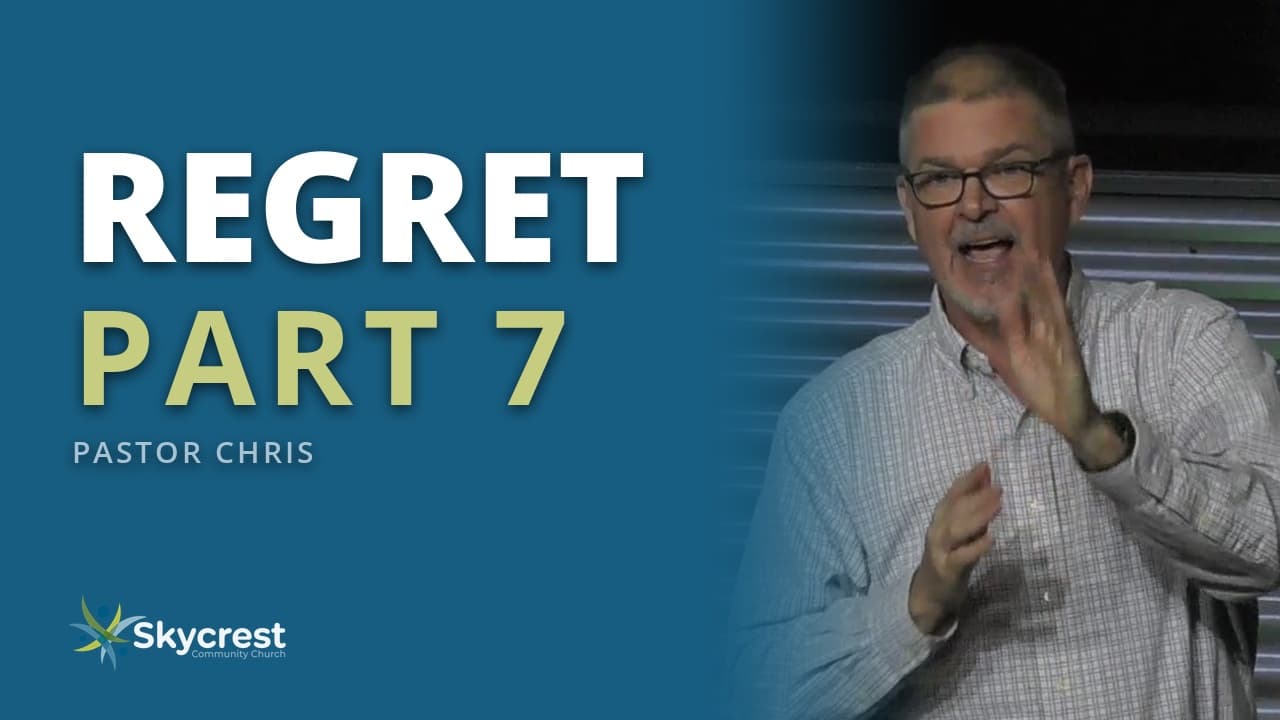
When regrets resurface after God has forgiven you, Pastor Chris said, recognize them as condemnation, not conviction, and resist them with Scripture. Then do what Paul did: remember your best day beside your worst day, turn your laments into lessons, and turn your regrets into resolve.
Why do old regrets keep coming back after God has forgiven me?
Pastor Chris said it plainly on the last Sunday of our Regret series: "I bet every person in this room could tell me your biggest mistake." You could probably name yours right now. The thing you just can't forget.
Here's the first thing we want you to hear. Remembering doesn't mean you're not forgiven. Pastor Chris said we are going to remember our sins and mistakes, and those memories usually arrive with a flood of regret. The trouble starts when that memory gets used against you.
According to Pastor Chris, our enemy exploits the memory. He wants us to believe we are what we've done, and that we should stay regretful for good. So the question that day was a simple one: what do we do with regrets that resurface when we remember our past failures?
That's what dealing with regret looks like for a forgiven person. It isn't about erasing the memory. It's about deciding what the memory gets to do.
What's the difference between conviction and condemnation?
Earlier in the series, Pastor Chris taught that regret can be a gift. The Holy Spirit uses it to alert us when we've gotten off track. When we're convicted, we look back at sin, confess it, receive the forgiveness God gives, repent, and walk on. Regret did its job, and it should disappear along with the sin it came with.
Condemnation is something else. Pastor Chris said conviction looks back at unconfessed sin and moves us forward in the grace of God, but condemnation looks back at forgiven sin and moves us backward. Conviction is good, and we should welcome it. Condemnation, he said, is always bad and must be resisted.
So how do we resist it? The same way Jesus resisted temptation in the wilderness, with Scripture. Pastor Chris pointed us to Romans 8:1, where Paul is saying, in effect, that there is now no condemnation for those who belong to Christ Jesus.
Pastor Chris also gave us two questions to sit with. Have you brought your worst moments to God and asked for forgiveness? And if you have, are those haunting memories still condemning you? If the answer to the first is yes, the second one has an answer too. You've been set free.
Does God really forget the sins he's forgiven?
In Isaiah 43:25, God says, in effect, that he blots out our transgressions for his own sake and remembers our sins no more. That's a big promise, and Pastor Chris slowed down to explain it.
He said the point isn't that God can't remember. God knows everything. The point is that he chooses not to remember. Pastor Chris described it this way: when God pulls your file and looks through the events of your life, the forgiven sins are redacted. He blots them out and opts not to hold them against us.
Pastor Chris said this is also the pattern for forgiving other people. It's not forgiving and forgetting, as we're so often told. It's forgiving someone and then choosing not to remember. We choose not to punish people in our hearts, our minds, or our interactions with them, the same way God chooses not to hold our offenses against us.
Here's where the enemy gets his foothold, according to Pastor Chris. He convinces us that God does hold those sins against us, and so we should too. We end up punishing ourselves for what God has already dealt with. If that's where you've been living, the passage invites you to stop agreeing with the accuser and start agreeing with God.
How did Paul handle the worst day of his life?
If anyone had reason to be stuck, it was Saul. Pastor Chris walked us through his story. Saul approved of Stephen's killing, the first Christian martyr, and then he began to destroy the church, going from house to house and dragging men and women off to prison. Then he set out for Damascus to do the same thing there.
Acts 9:1-20 tells what happened next. A light from heaven flashed around Saul, and he heard Jesus say that he was the one Saul was persecuting. Saul was blind for three days, fasting and praying. Then Ananias, who was understandably nervous, obeyed the Lord, welcomed Saul as a brother, and laid hands on him. Saul was filled with the Holy Spirit, was baptized, and at once began to preach that Jesus is the Son of God. Saul became Paul.
Then Pastor Chris asked the question that matters for us. Did Paul forget? "He didn't forget. How could he?" Pastor Chris said he imagines the sights and sounds of Stephen's death coming back again and again, and with them the sting of regret.
He pointed to Philippians 3:7-14, where Paul writes about counting his old achievements as loss for the sake of Christ, forgetting what is behind, and straining toward what is ahead. That doesn't sound like a man who forgot, Pastor Chris said. It sounds like a man who remembered vividly. He also told us the Greek tense behind the word forgetting means to forget and keep on forgetting. Paul had to do it over and over, every time the memory came back.
How do I turn regret into resolve this week?
Pastor Chris said Paul did three things with his past.
First, he remembered his best day alongside his worst day. They sat close together: the killing of Stephen and the meeting with Jesus. Pastor Chris said the best day is the day Jesus sets you free from the pain and regret of the worst one.
Second, Paul turned his laments into lessons. He asked what he could learn from who he'd been and what he'd done. Pastor Chris said that meant Paul would no longer live to please people but would live to please God.
Third, Paul turned his regrets into resolve. He used them as motivation to press into his future with Jesus. Pastor Chris said it plainly: "Grace is not opposed to effort, it's opposed to earning." We don't earn a relationship with Jesus, but we do put effort into having one.
None of this is Paul trying to make up for his past. Pastor Chris said God had already forgotten all that. Paul simply refused to let his past distract him from his future. According to Pastor Chris, we face the same choice when the worst thing we've ever done comes flooding back. We can let it distract and derail us, or we can let it direct us. And he asked which memory carries the most weight in your mind: the garbage of your past, or the day you met Jesus.
If you've never placed your faith in Jesus, Pastor Chris said today can be your best day. Jesus lived a perfect life, died on the cross to take our punishment, and rose again so we could be forgiven and have life.
So here's one thing for your week. The next time that memory shows up, stop and say out loud the name of your best day, the day you met Jesus and were set free. Then ask one question about the worst day: what can I learn from it? And if you want someone to pray with you, we'd love to do that. Reach out to us at Skycrest Community Church.
Key takeaways
- Remembering a forgiven sin doesn't mean you're unforgiven. Pastor Chris said we will remember, but we choose what the memory does.
- Conviction looks back at unconfessed sin and moves us forward. Condemnation looks back at forgiven sin and pulls us backward.
- Pastor Chris said Isaiah 43:25 means God chooses not to hold our forgiven sins against us.
- Paul remembered his past vividly, so he had to forget and keep on forgetting, according to Pastor Chris.
- Paul remembered his best day, turned laments into lessons, and turned regrets into resolve.
Scripture in this message
- Romans 8:1 (NIV)
- Isaiah 43:25 (NIV)
- Acts 9:1-20 (NIV)
- Philippians 3:7-14 (NIV)
Frequently asked questions
What is the difference between conviction and condemnation?
Pastor Chris said conviction comes from the Holy Spirit and looks back at unconfessed sin, then moves us forward in God's grace. Condemnation looks back at forgiven sin and moves us backward. We welcome conviction, and we resist condemnation, always, with Scripture.
Why do I still feel regret after God forgave me?
Pastor Chris said we will remember our sins and mistakes, and the memories often bring a flood of regret. The enemy uses those memories to convince us we deserve condemnation. Forgiven sin can still be remembered, but it doesn't have to condemn us.
Does God forget our sins?
Pastor Chris explained that Isaiah 43:25 doesn't mean God can't remember, since he knows everything. It means he chooses not to. He blots out our forgiven sins and opts not to hold them against us.
Did the apostle Paul have regrets about his past?
Pastor Chris said Paul couldn't have forgotten what he did, including approving of Stephen's killing and persecuting the church. Philippians 3 shows a man who remembered vividly, yet chose to forget and keep on forgetting what was behind and press on.
How can I turn my regrets into resolve?
According to Pastor Chris, Paul did three things. He remembered his best day beside his worst day, turned his laments into lessons, and let his regrets become motivation to press toward what Christ has ahead. Grace isn't opposed to effort, he said.
What if I've never placed my faith in Jesus?
Pastor Chris said that day can be your best day. Jesus lived a perfect life, died on the cross to take our punishment, and rose again so we could be forgiven. You can open your heart and believe, and we'd be glad to pray with you.